"I’ve never been to a food business where there wasn’t an opportunity to reduce food waste!"
Reducing food waste is a huge opportunity that is still to be seriously addressed by many food businesses.
While lean manufacturing tools can reduce food waste through improved process efficiency, there are still significant gains that can be made when food waste reduction is targeted across the entire production process.
How do you start?
I use a step-by-step process – here’s a process flow of how it works.
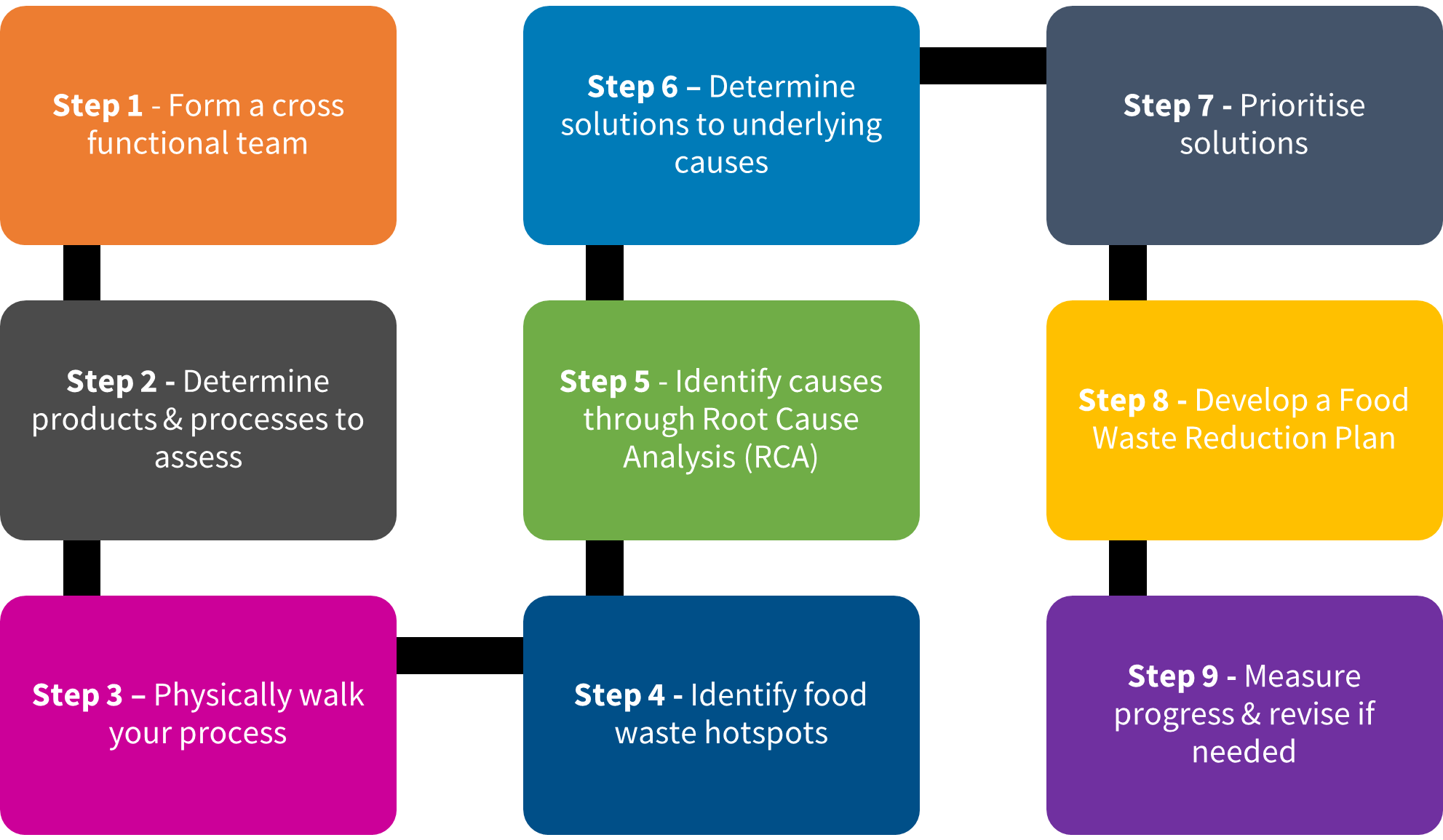
Here’s a breakdown of each step:
Step 1: Form a cross-functional team
Form a cross-functional Food Waste Action Team to ensure diverse perspectives with a single focus on reduce food waste ideally seeking representatives who perform the functions for Sustainability, Supply Chain, Operations, Technical (Quality), Data Analytics, NPD and Management to ensure diverse expertise & perspectives.
- Sustainability: develops waste reduction strategies and ensures environmental compliance.
- Supply Chain: optimises procurement and distribution, preventing overstocking that leads to waste.
- Operations: streamlines processes and inventory management to minimise spoilage, enhancing efficiency.
- Technical (Quality): provides insight and experience in systems, compliance and risk management.
- Data Analyst: tracks patterns and identifies inefficiencies, providing actionable insights for improvement.
- NPD: innovates with packaging and preservation techniques, extending shelf life, packaging functionality and reducing spoilage.
- Management (& Accounting): evaluates the cost implications, ensuring initiatives are financially viable for the business.
Expert Tip: If you are a solo advocate for reducing food waste in your business, start by building momentum, then collaborate with diverse functions across your business to drive a holistic, data-driven approach to waste reduction, improving efficiency & profitability.
Step 2: Determine products & processes to assess
Start with products and processes you know or suspect generate higher food waste compared to others.
Expert Tip: Start by targeting your highest volume products as any food waste reduction for these products will be impactful.
Step 3: Physically walk your process
Walk through the production process with the Food Waste Reduction team to observe every step of the process, from start to finish. Food waste outputs should be obvious when observing the process. Talk to operators to understand when the waste occurs and what the worst case scenario is.
Expert Tip: Take photos & videos as evidence you can use for discussion with the Food Waste Reduction team to identify hotspots and their root causes.
Step 4: Identify food waste hotspots
When identifying food waste hotspots, key considerations include the quantity and the value or cost of the product as an ingredient, intermediate or value-added item. The cost of food waste disposal is also an important consideration as this is a direct operational expense. Other considerations include the compositional value of waste as high protein, fat or functional constituents can offer transformation or upcycling opportunities.
Expert Tip: Money talks! Make sure you cost out the savings from reducing food waste in your business. Monetary losses from food waste includes ingredients procured but not converted to saleable products and the loss in sales from unsold products.
Step 5: Identify causes through Root Cause Analysis (RCA)
Many food business have found that there are multiple causes for each and every food waste hotspot. Understanding all of the underlying causes will help you to identify the range of actions needed to consistently and effectively reduce waste.
Expert Tip: Use tools like the “Fishbone Diagram” & “5 Whys” to drill down on contributing factors and underlying causes of your food waste at each process step.
Step 6: Determine solutions to underlying causes
Each food waste hotspot may require a tailored solution, often supported by changes in operator behaviour and company culture.
Process solutions can include:
- Redesigning or modifying processes
- Replacing or modifying equipment
- Upgrading software for automated systems
Product solutions can include:
- Reformulating products
- New product development projects focused on repurposing food waste to another product
- Adjusting ingredient specifications
Expert Tip: Trial solutions first to check that they can be sustained for more than just a quick fix.
Step 7: Prioritise solutions
Expert Tip: Focus on the areas that will provide a quick return on investment demonstrating the benefit of food waste reduction initiatives to the business.
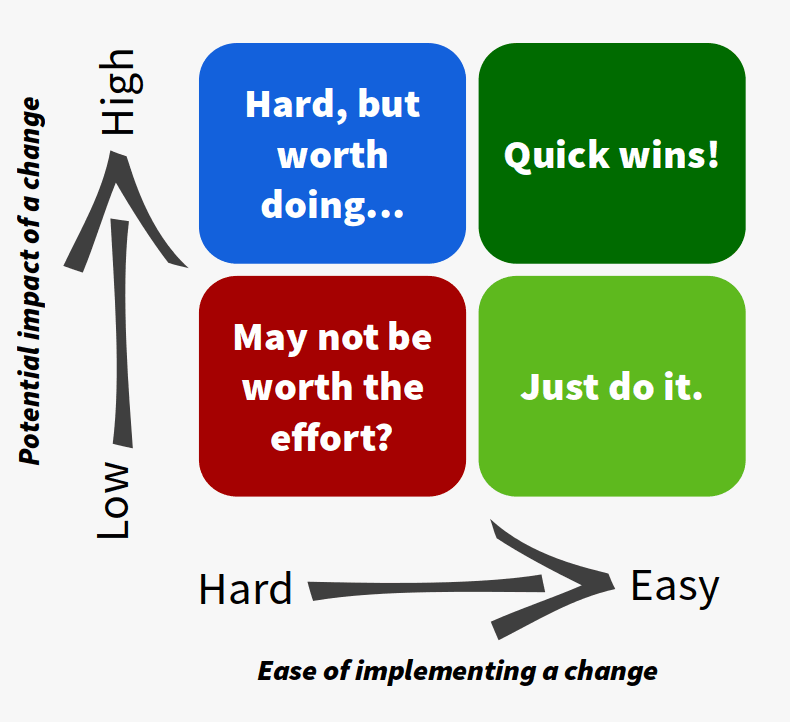
Rank your solutions using a cost-benefit matrix to prioritise actions that will have the most impact with the least effort. This is a practical decision-making framework to prioritising actions.
- First, list potential actions (e.g, improving inventory tracking).
- Assess each action’s impact (high or low) on reducing waste, considering factors like volume and cost savings, and its ease of implementation (hard or easy), based on resources, time, and complexity.
- Plot the actions on the matrix:
- “Just do it” (low impact, easy to do) for quick, minor tasks;
- “Quick wins” (high impact/easy to do) for immediate priorities;
- “Hard, but worth doing” (high impact/ hard to do) for long-term strategic efforts; and
- “May not be worth the effort” (low impact/ hard to do) as the lowest priority.
Expert Tip: This is a great sorting tool to help prioritise and it will be obvious where you need to focus your efforts for maximum impact.
Step 8: Develop a Food Waste Reduction Action Plan
Create timelines and assign responsibilities for all food waste reduction actions. Identify corresponding monitoring activities to collect data and track your progress towards reduction targets.
Expert Tip: Aligning individual Key Performance Indicators (KPIs) with targeted food waste reduction actions promotes accountability for planned initiatives.
Step 9: Measure progress & revise if needed
Measure your food waste reduction progress at regular intervals by tracking key metrics, like waste volume and cost to assess the effectiveness of your actions. Ongoing evaluation will help to ensure alignment with reduction targets and continual improvements.
If the actions fail to deliver the expected results, revise them by adjusting strategies, resources, or timelines to maintain momentum toward waste reduction goals.
Make a start!
You can begin with just one product, made on one production line.
Reducing food waste will lower your operating costs by minimising expenses on raw materials, waste disposal and lost sales. You’ll also likely improve your production efficiencies and inventory processes. All of which in turn will increase your profitability.
Right now is a great time to get started!
As always, if you need any help with the process, don’t hesitate to get in touch!