In the fast-paced world of food manufacturing, change is inevitable and having an effective change management process in place is critical.
Whether it’s the result of a change in the market or introducing a new ingredient, upgrading equipment or updating food safety protocols, the only constant with change, is that it’s here to stay.
A robust change management process ensures that changes are thoroughly risk-assessed, carefully planned, and effectively implemented, with follow-up evaluations to safeguard food safety and quality.
"Even small changes, if not properly risk-assessed and carefully managed, can have widespread consequences for food safety."
With food safety being paramount, change management aligns with Hazard Analysis and Critical Control Points (HACCP) principles and will be a future requirement in GFSI standards like FSSC 22000, BRCGS Food and SQF Food Safety Program.
What is change management?
Change management is a structured process to identify, evaluate, approve, implement and verify changes within food manufacturing operations.
The intent is to control changes to prevent or limit the negative impacts on food safety, product quality, regulatory compliance and operational efficiency.
Where does it apply?
Change management is essential for any modification that could affect food production. Common examples include:

Each of these changes, if mismanaged, could introduce food safety risks.
9 Change management strategies...
1. Engage your stakeholders
Involve all relevant functions in your business; Production, Quality Assurance (QA), Procurement, New Product Development (NPD) and management – from the start.
- Examples of how to do this:
Host briefings to explain the proposed changes. Example: The introduction of a new allergen control process. - Use visual aids like flowcharts, pictures or videos where possible to communicate changes.
- Provide targeted training to the relevant roles to ensure the new requirements are clearly communicated and understood.
Expert Tip: This is essential to align everyone on food safety priorities and to foster collaboration. Clear communication from the start of a proposed change will build trust and reduce resistance to the change.
2. Conduct thorough food safety risk assessments
Evaluate potential food safety hazards and operational risks before implementing the change.
Examples of how to do this:
- Apply HACCP principles to assess product and process hazards. Determine any significant hazards to be expected from the proposed change. For example, completing an allergen hazard review for the introduction of a new allergens to identify any cross-contact risks.
- If there are significant food safety hazards identified with the proposed change, review the existing controls for Critical Control Points (CCPs) or Operational Prerequisite Programs (OPRPs), to determine if they prevent, reduce to acceptable levels or eliminate the risk from the change or propose new controls as needed.
- Document the risk assessment methodology and findings for the change, including any required trials or external consultations with laboratories or Regulatory Bodies.
Expert Tip: This is necessary to ensure that any new food safety hazards are identified and appropriate controls are implemented to comply with regulations and industry standards.
3. Test your changes
When the proposed change could have a significant impact on food safety, you need to conduct a proof of concept. This could be in the form of a desktop review, small scale pilot or a trial to identify potential issues and their consequences prior to full implementation.
Examples include:
- When introducing a new ingredient, a small scale pilot can be used to confirm the food safety, quality & sensory attributes.
- When upgrading equipment on a production line, a trial could be completed to reveal any contamination risks or equipment functionality issues before scaling up.
- When there is a change in a CCP critical limit, a desktop review will be your first step to validate the theoretical correctness of the limit and the process capability to consistently achieve this.
Expert Tip: Forecast the impact of changes to minimise disruptions and maintain food safety and quality during equipment and process related changes.
4. Prioritise learning & skill development
Provide employees with the knowledge, skills and support they need to effectively implement changes to products and processes, or for the introduction of new technologies.
Examples of how to do this:
- Train staff on updated cleaning protocols to prevent cross-contamination.
- Use hands-on sessions, mentoring and tools such as checklists, to provide a prompt on the required food safety practices to support the change.
Expert Tip: Providing training and supervision during changes will reduce human error – a common cause of food safety issues.
5. Update documentation
Ensure all changes are carried over to system documentation.
An example of how to do this is to revise your SOPs and your record templates to reflect the change.
Expert Tip: Simplify change implementation by providing clear, documented guidance.
6. Secure leadership commitment
Ensure leaders actively support and drive accountability for changes.
Examples of how to do this:
- Have senior management champion the change management process.
- Assign managers and team leaders to oversee the implementation and compliance.
Expert Tip: Leadership support aligns the organisation with food safety goals and secures resource allocation.
7. Establish feedback channels & continuous improvement
Create communication pathways to facilitate feedback following the change, and monitor performance to make any adjustments needed.
Examples of how to do this:
- Ask for operator feedback on the changes, for example the introduction of new equipment or process efficiency.
- Track defect rates to assess change impacts.
- Conduct post-implementation assessments to verify the effectiveness of food safety controls.
Expert Tip: This approach identifies issues early and supports ongoing compliance.
8. Foster cross-functional collaboration
Review the impact of the change across different functions in the business.
Examples of how to do this:
- Form a cross functional review team to evaluate the impact and effectiveness of the change, for example, the use of a new packaging material.
- Assess downstream impacts, such as labelling compliance or shelf-life testing.
- Engage suppliers early when making changes to raw materials to ensure they are able to provide the required evidence of compliance such as evidence of packaging suitability.
Expert Tip: Effective collaboration ensures cohesive decision-making to comprehensively address food safety and operational impacts.
9. Monitor & verify the change after implementation
Continually monitor changes to ensure long-term effectiveness of the change.
Evaluate the effectiveness of the change using these prompts:
- Has the change achieved its intended outcomes?
- Are stakeholders aware of, and understand the changes?
- Are performance metrics showing improvement?
- Are managers taking ownership of new processes and behaviours?
- Have responsibilities for ongoing tasks been assigned to teams?
- Is ongoing support, like mentoring or reviews in place?
Expert Tip: This enables evaluation of the change and refinement of the change to achieve the desired outcome.
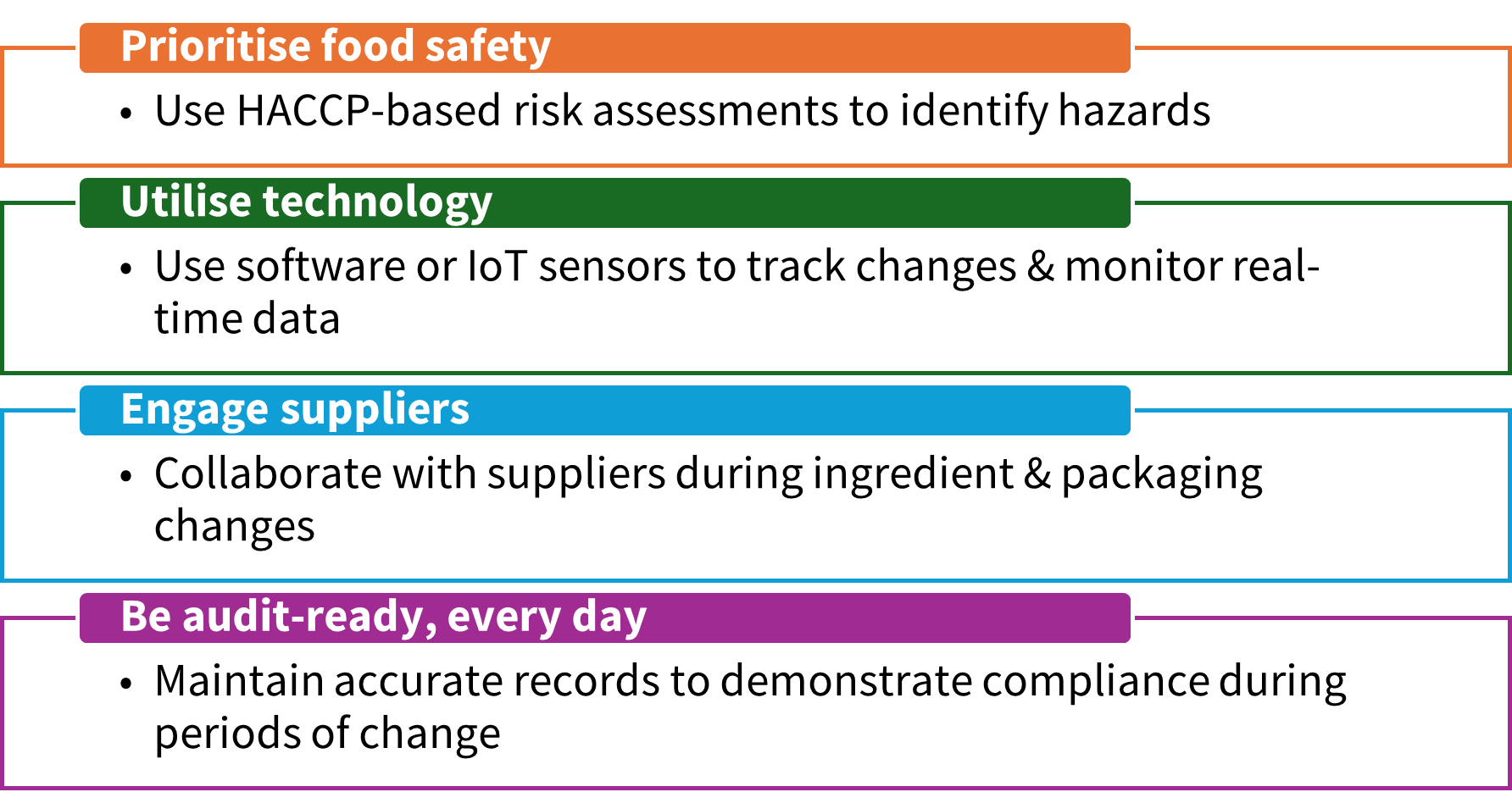
Tips for success...
"By addressing potential risk, effective change management ensures that modifications enhance, rather than compromise the production process."
By applying these strategies, manufacturers can implement changes smoothly, minimise risks and maintain trust in their products.
Whether you’re introducing a new ingredient or upgrading a production line, a robust change management approach ensures your operations remain safe, efficient and compliant.
Change management will be a new requirement in the upcoming GFSI Food Safety Standard revisions, so start developing your strategy now.
As always, if you need help to create & implement an effective change management strategy in your business don’t hesitate to get in touch!