"By collaborating and sharing data-driven insights, you and your supply chain partners can address food waste hotspots, reduce costs and increase profits."
We’ll outline an approach to identify supply chain food waste hotspots and their causes. Then look at some key strategies to reduce waste across end-to-end supply chains.
Collaboration is key...
Reducing food waste across the supply chain requires a cooperative, strategic approach from farm to table, in partnership with other food businesses. Each business plays a vital role in addressing the complex challenges of food waste, including the perishability of products, logistical hurdles in global supply chains, economic constraints and behavioural influences.
A holistic, inclusive approach will help to reduce food waste, not simply shift it from one supply chain partner to another.
Here's how...
To confidently deal with the inherent complexity of food waste across a supply chain, we suggest breaking the process down into a series of manageable steps.
Step 1: Conduct a joint supply chain review
Begin by partnering with upstream suppliers, downstream service providers and customers to map the entire chain. Host a collaborative workshop to bring your key supply chain partners together in the same place at the same time, to promote open dialogue and shared insights.
Expert Tip: You may not have a team approach to start your actions, however by engaging with a diverse cross section of functions, you can drive a holistic, data-driven approach to waste reduction, improving efficiency & profitability.
Step 2: Map each stage of the supply chain
Track a specific product’s path through its supply chain by “walk the chain” from primary production, detailing every handover to each supply chain partner all the way through to the consumer.
Here’s an example of a supply chain for ready-to-eat leafy greens.
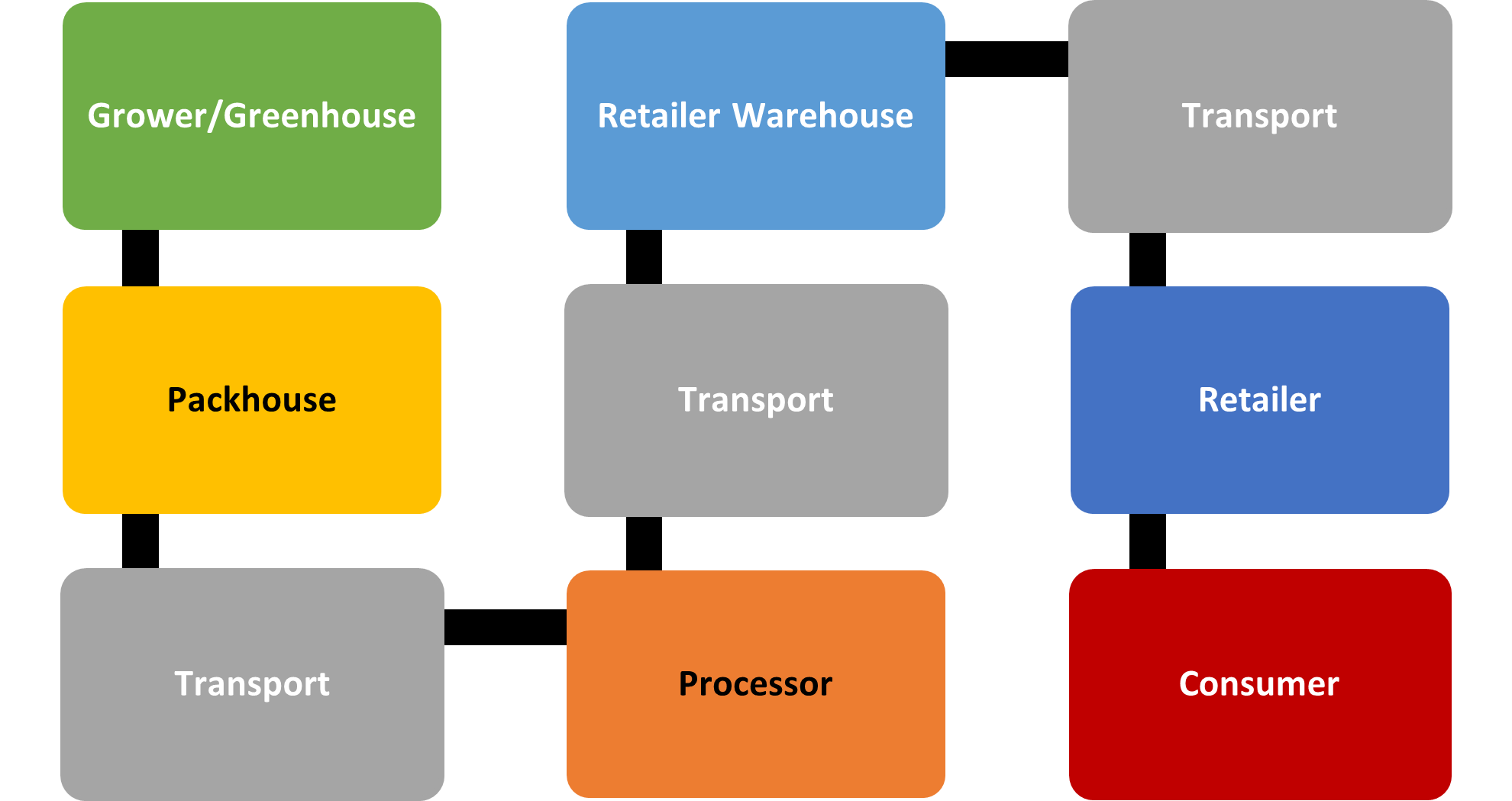
Expert Tip: Each supply chain partner has the potential to generate food waste so it’s important that all supply chain partners are mapped.
Step 3: Overlay the communication pathways
Communication, or lack of communication can be a significant driver of food waste. Returning to the map of your supply chain, add the communication pathways and the reason for the communication. Recognise that communications and the flow of information is not always linear and feedback loops from retailers to growers, or packhouses to retailers should be encouraged.
Here’s an example of communication pathways between supply chain partners.
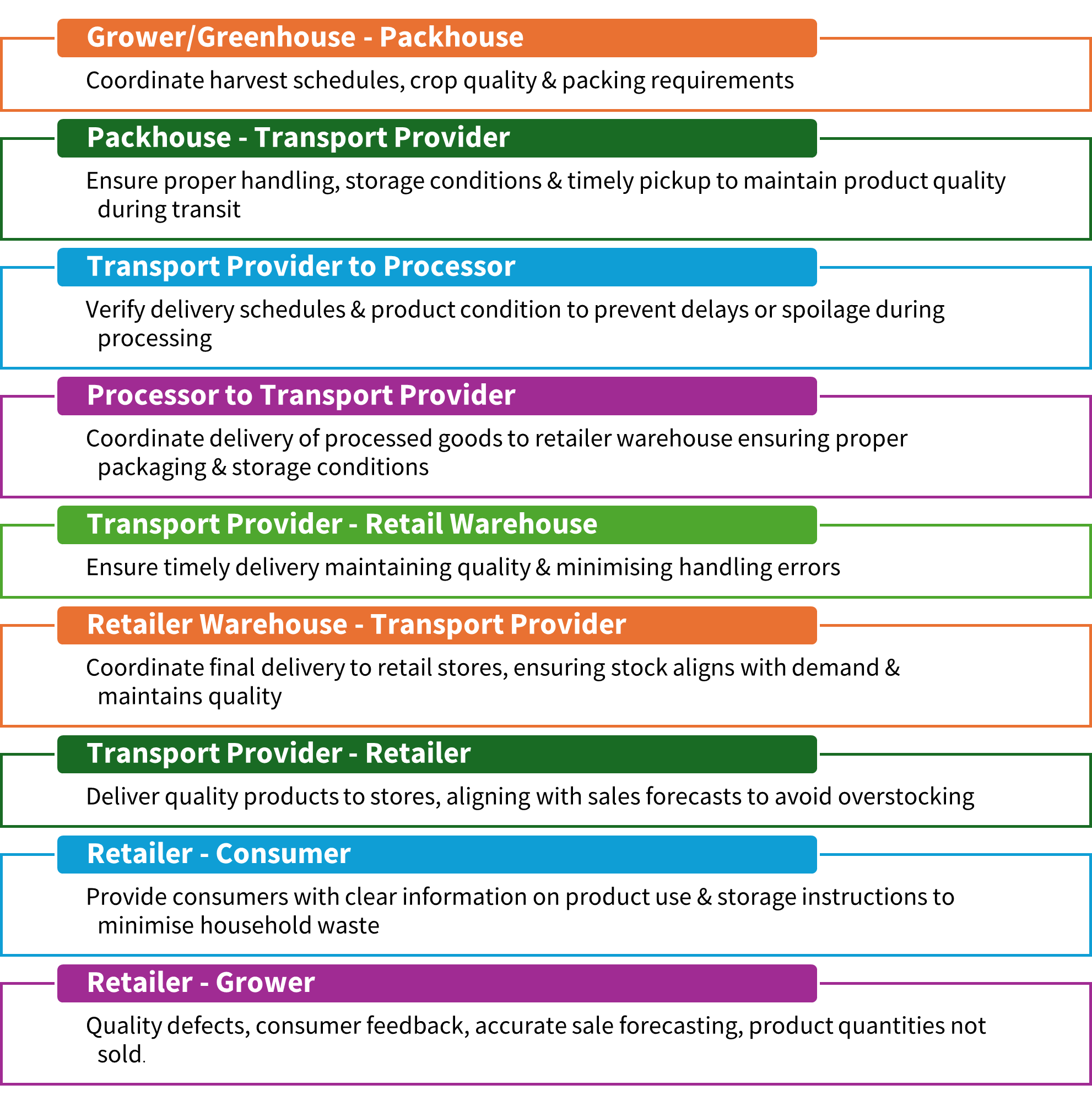
Expert Tip: Prioritise areas of potential miscommunication.
Step 4: Identify food waste hotspots
Pinpoint key stages in the supply chain where significant food waste occurs, such as unsuitable crop varieties, deliberate overproduction, spoilage during transport or discarded food at the retail level.
Step 5: Assess cross-chain impacts
Analyse how actions taken by one supply chain partner may contribute to waste in upstream or downstream stages of the supply chain.
For example;
- Product specifications: Retail cosmetic standards for produce result in rejections for items with minor defects. This reduces retail-level waste but increases waste for farmers, who are left with edible but unsaleable produce that may be discarded or repurposed at a financial loss.
- Overstocking: A distributor may deliberately overstock perishable goods to ensure their retailers or food service customers have sufficient supply during peak demand periods. If the products don’t sell at retail level as anticipated, distributors may be forced to discard product which is short-dated or close to expiry date.
- Consumer behaviour influenced by promotions: A retailer offers bulk discounts on perishable items, encouraging consumers to buy more than needed. This reduces waste at the retail level by clearing inventory but shifts waste to consumers, who may throw away excess food that spoils before consumption.
Step 6: Prioritise high impact opportunites...
- Focus your efforts on the hotspots where there is the greatest potential to reduce food waste.
- Collaborate with key decision-makers to ensure effective implementation.
- Promote equitable cost and benefit sharing by agreeing on a fair distribution of costs and gains among supply chain partners.
Key strategies...
Strategies to reduce food waste might combine technology adoption, process optimisation and consumer engagement to help tackle waste. Here’s some examples that may apply to your supply chain.
1. Improve forecasting accuracy
Retailers can invest in demand forecasting software to enable more precise ordering of perishable goods from distributors.
Inaccurate orders can cause overstocking pressure, which often leads to discounting and waste at the retail level. The excess inventory could also be pushed back onto distributors, who may then have little choice but to discard unsold products.
Expert Tip: Precise forecasting reduces waste downstream at both the retail and consumer stages by better matching supply to demand.
2. Seek innovative packaging formats
Processors can invest in designing and implementing improved packaging solutions to overcome some of the main waste drivers for particular products.
Examples include providing extra protection during distribution to prevent packaging failure, extending shelf life, allowing for better portion control and enhancing usability to reduce consumer-level waste.
3. Educate consumers on date marking
Manufacturers can help reduce consumer waste by providing clear information on “best before” dates to prevent safe, edible food being prematurely discarded. Storage or handling instructions to extend the shelf life of certain products, such as freezing bakery items, can also reduce consumer waste.
Expert Tip: Join industry wide campaigns to reduce food waste by promoting better understanding of date markings.
4. Maintain integrity of the cold chain
Minimise loading delays and temperature fluctuations by verifying that refrigerated transport systems are capable of maintaining consistent product temperatures for food safety and quality, reducing spoilage and waste.
Expert Tip: Utilise data loggers and IoT sensors for real-time monitoring to detect issues promptly and validate cold chain integrity with reliable data.
5. Optimise transport logistics
Prioritise efficient routing and standardise handling practices across multiple transport providers to ensure consistency in handling practices to minimise waste.
Expert Tip: Use GPS-enabled route optimisation and real-time tracking to reduce transit times.
6. Invest in technology
Supply chain partners from growers, processors, distributors, retailers and even waste management entities can collaboratively fund and implement technologies to optimise processes, improve tracking and enhance food preservation.
Expert Tip: Reduce food waste by leveraging shared resources to deploy tools like IoT sensors, predictive analytics, blockchain and cold chain innovations.
Adopt a big picture view...
Unite your supply chain through a common goal of food waste reduction.
Don’t wait for regulations, customer or consumer demands — lead the change by initiating collaboration with your supply chain partners. The hardest part will be deciding when to start.
As always, if you need any help with the process or to facilitate a stakeholder workshop, don’t hesitate to get in touch!